BSG Clinical Services Excellence Award 2026 highly commended submission by Julia Pakpoor, Clinical Research Fellow in Gastroenterology.
Acknowledgements: Prof Simon Travis, Cushla Cooper, Dr Alissa Walsh, Jane Okomoku, Divya Saji, Julia Wood, Penny Love, and Prof Christopher Buckley.
The Challenge: Why Change Was Needed
When patients with ulcerative colitis (UC) experience a flare, timely endoscopic assessment is essential to guide treatment decisions. Yet, the ability to achieve this has long been limited by existing pathways and practical capacity at Oxford University Hospitals (OUH). By April 2023, the wait for a new IBD clinic appointment had reached 28 weeks for face-to-face and 46 weeks for telemedicine, with over 4,000 patients on the waiting list at any one time. Endoscopy access has been similarly stretched with a 17 week wait for routine flexible sigmoidoscopy, and 10 weeks for an urgent flexible sigmoidoscopy.
These waits have carried real clinical consequences. Many patients were kept on empirical steroid courses without the mucosal assessment needed to escalate therapy. This meant avoidable side effects, prolonged symptoms, and uncertainty. For clinicians, patients were scattered across ad hoc lists with typically no dedicated time for senior review or treatment planning to happen. There was simply no mechanism to ensure that patients at a critical disease timepoint were seen rapidly, by the right team, with the right investigations, in one place.
The problem extended beyond individual patient care. Without a dedicated flare pathway, research requiring consistent access to patients at a defined disease timepoint was severely constrained. Eligible patients were dispersed across lists and sites, making systematic recruitment and longitudinal sampling impractical. This is not unique to Oxford but reflects a systemic limitation of conventional IBD service design in the NHS.
Overcoming the Challenge
In Autumn 2023, we developed and introduced a new model of care, the ‘Sagittarius’ UC flare service: a dedicated, weekly UC flare clinic and endoscopy service delivered at the NIHR Experimental Medicine Clinical Research Facility (EMCRF), a joint NHS–University of Oxford facility. This was the first time a standard-of-care NHS clinical service had been delivered within the EMCRF, representing a novel approach to NHS–University collaboration.
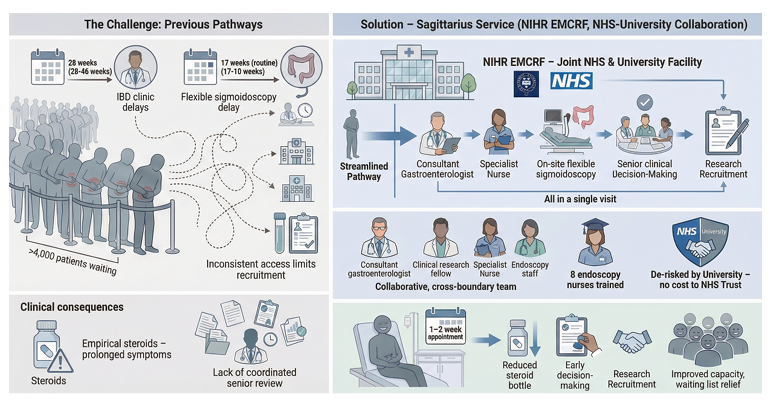
The service brings together consultant gastroenterology review, specialist nurse assessment, on-site flexible sigmoidoscopy, senior clinical decision-making, and, where patients consent, integrated research activity, all within a single visit. This one-stop model eliminates the fragmented pathway that previously characterised UC flare management. Crucially, the model was made possible by the University of Oxford de-risking the initiative through dedicated funding and infrastructure. The University enabled NHS clinicians to use state-of-the-art facilities at no cost to the Trust, while the service integrated seamlessly with existing OUH clinical and governance pathways. Further, through delivery of the service, eight endoscopy nurses were trained, creating capacity for workforce development. This new service was developed to remove the financial and operational barriers that would otherwise have prevented innovation within a pressured NHS environment.
The multidisciplinary Sagittarius Team work together across traditional organisational boundaries. Their collaborative approach has been fundamental to establishing and sustaining the service over what is now its third year of operation, with almost 200 UC flare clinic/endoscopy lists completed.
Outcomes
The impact on patient care has been substantial. Within the Sagittarius UC flare service, appointments are booked just one to two weeks in advance, compared with the 17-28 week waits which patients previously faced (Figure 1 & Figure 2). This has enabled earlier, senior-led treatment decisions in a purpose-built environment. For the NHS, the service has delivered over 2.5 years of weekly endoscopy and clinic lists, increased the ‘standard-of-care’ capacity and reduced waiting list pressures at no financial cost to the Trust. Therapeutic decisions are made at the time of endoscopy and implemented immediately with the support of IBD specialist nurses, rather than waiting for a clinic follow-up appointment. For the University, research recruitment has increased 10-fold.
Figure 1. Waiting times for endoscopy and IBD clinic appointments compared with the Sagittarius UC Flare Service
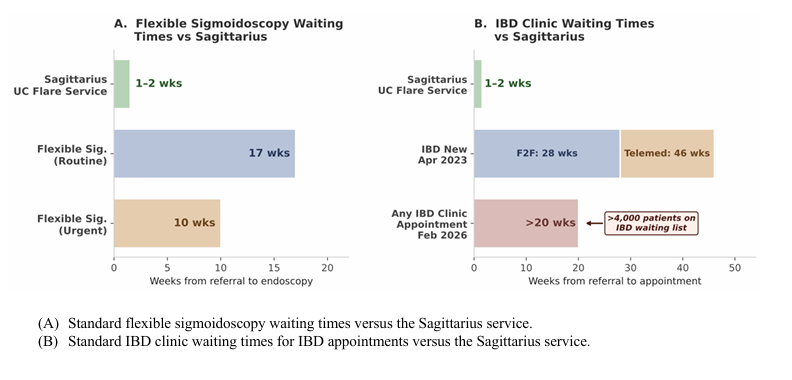
Figure 2. Sagittarius UC Flare Service: A One-Stop Multidisciplinary Solution
The integrated clinical care–research design has produced significant scientific outcomes. By concentrating UC flares within dedicated sessions, the team has enabled consistent recruitment and longitudinal sampling that was previously impossible, generating novel findings. These scientific results have been selected for plenary presentation at the world's largest international IBD meeting (ECCO) in 2026, representing a recognition of both the scientific results and the strength of the clinical model underpinning them.
Patient feedback highlights both the perceived quality of care and the acceptability of research integrated within routine clinical practice. One patient described their experience of the service: “The staff were so knowledgeable, friendly and welcoming, and the facilities were excellent. I feel privileged to participate…particularly so those in the future can have a smooth path from diagnosis to treatment.”
Patients also reflected on the importance of active participation in research to improve future care: “It’s not that people are resistant to research, they just don’t know enough about what it is for, and why it is needed.”
We therefore believe that this service truly delivers a three-way benefit: patients receive faster multi disciplinary care; the NHS gains capacity without financial risk; and researchers gain access to well characterised cohorts.
Learning Points and Influence on Other Teams
The process of establishing and running the Sagittarius Service has presented transferable learning insights. Firstly, it demonstrates that University infrastructure can be leveraged to solve NHS service pressures, provided that the model is designed to be mutually beneficial. Secondly, the programme shows that integrating research into routine care - rather than treating each as separate activities - can improve both. This challenges the commonplace assumption that clinical care and research compete for time and resources. Thirdly, this replicable framework can be applied to any condition where biological sampling alongside standard of care could accelerate translational discovery. Locally, plans are underway to expand the approach in 2026 to Crohn's disease, coeliac disease, anorectal cancer, and rheumatological conditions.
The Sagittarius Team seek to demonstrate clinical service excellence, not only through measurable outcomes but also through the culture which it has built: a diverse, multidisciplinary group working across institutional boundaries with shared purpose, demonstrating that thinking differently about how, and where, care is delivered can result in sustained improvements for patients and wider IBD services. We hope that the programme provides a scalable blueprint for NHS–University collaboration that others can adapt to their local context.
Read More